
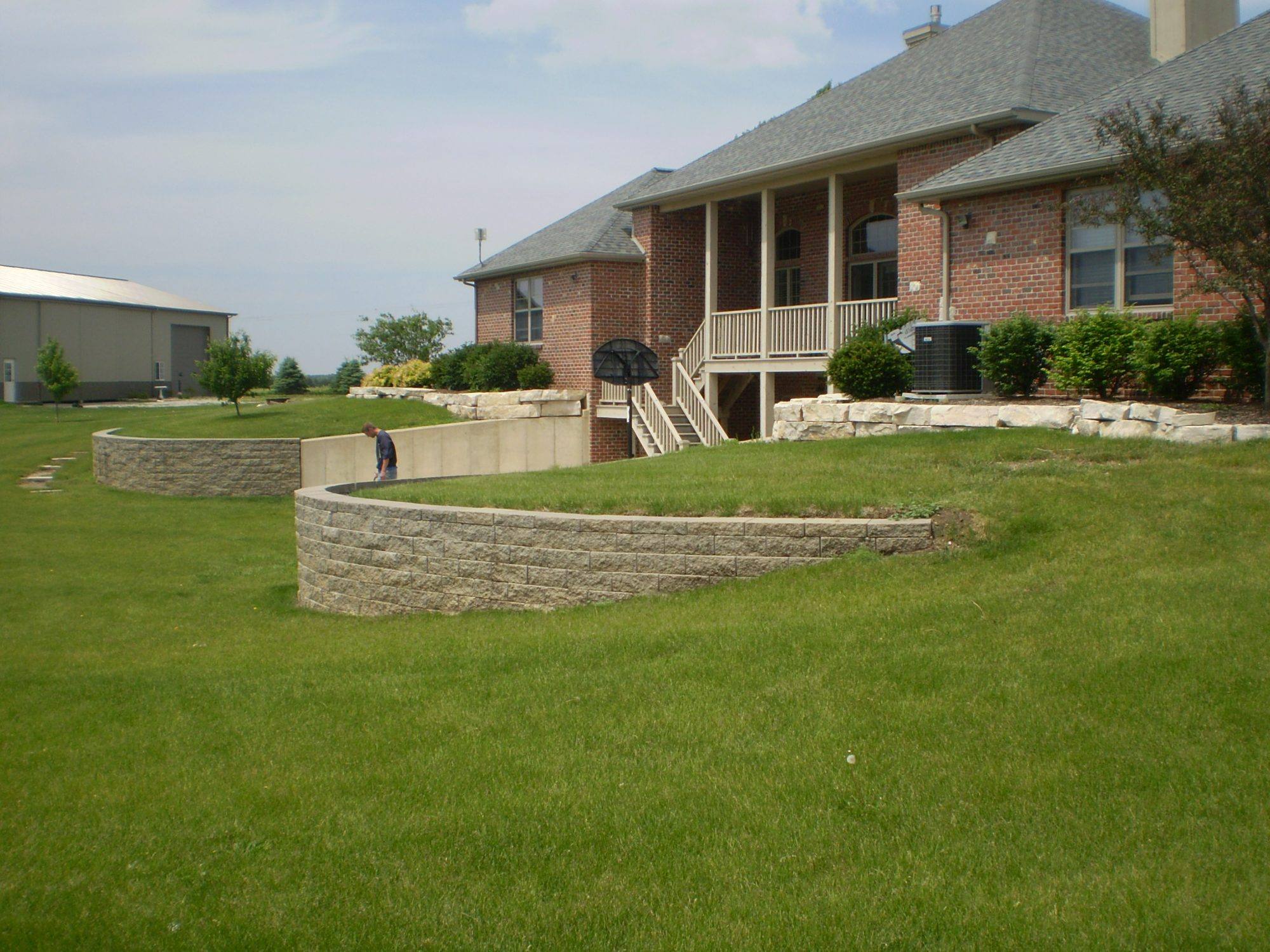
A retaining wall can turn a sloped, hard-to-use yard into flat, usable space. It can also stop soil from washing out, create raised planting beds and frame a patio. But a wall is a structure holding back a lot of weight, and how it is built matters as much as how it looks. This guide explains what retaining walls typically cost in Bloomington-Normal, what affects the price and what to look for so your wall stays straight for the long haul.
F&W Lawn Care & Landscaping is a family-owned Bloomington company that has served Central Illinois since 1989. We design and build retaining walls for homes throughout the area, and the figures below are our own typical ranges.
Typical Retaining Wall Cost
Retaining walls are usually priced by the square foot of wall face, meaning the length of the wall multiplied by its height. That captures both how long and how tall the wall is, since a taller wall needs more block, more base and more backfill.
| Project | Typical Range |
|---|---|
| Retaining wall, per square foot of wall face | $20–$50, depending on material and height |
| Most residential retaining walls | $3,000–$10,000 |
| Taller walls or walls needing engineering or permits | Higher than the typical range |
These are typical ranges, not set prices. We will give you a free quote after we look at your slope, soil and goals.
What Affects the Cost of a Retaining Wall?
Wall Height
Height is the biggest factor after length. A short garden wall that edges a planting bed is a fairly simple project. As walls get taller, the soil behind them pushes harder, so they need a deeper base, more drainage stone and often reinforcement tied back into the hillside. Taller walls may also need an engineered design and a permit, which adds cost. Requirements vary, so check with your city before planning a tall wall.
Material
- Segmental retaining wall block: The most common choice for residential walls. These interlocking concrete blocks stack without mortar, come in many colors and textures and are built to handle freeze-thaw movement.
- Natural stone: Boulders or cut stone give a more natural, high-end look. Material and labor both cost more because every piece is different.
- Timber: Lower up-front cost, but wood eventually rots in the ground and needs replacing. Most homeowners who want a long-term wall choose block or stone.
Length and Layout
Long, straight runs are the most efficient to build. Curves, corners, steps built into the wall and walls that step down a slope in tiers all take more cutting and fitting.
Site Access and Excavation
Retaining walls involve digging into a hillside and moving a lot of soil and stone. If equipment can reach the work area easily, the job goes faster. Tight access, mature trees, fences or buried utilities can add time.
Drainage Needs
Every retaining wall needs a way to let water out from behind it. Yards with heavy runoff or a history of standing water may need extra drainage work, which we cover more below.
Caps, Lighting and Extras
Finished caps, built-in steps, integrated seat walls and lighting add to the total but give the wall a polished, finished look. Low-voltage landscape lighting tucked under wall caps is a popular add-on, with fixtures typically $100–$300 each installed.
Why Drainage Behind the Wall Matters in Central Illinois
Most retaining walls do not fail because the block breaks. They fail because of water. Central Illinois has heavy prairie clay that holds moisture, and when that wet soil freezes it expands. If water cannot escape from behind a wall, the pressure builds until the wall leans, bulges or tips over.
A well-built wall includes:
- A compacted gravel base set below grade so the first course sits level and firm.
- Clean drainage stone directly behind the block, so water can move down instead of pushing outward.
- A perforated drain pipe at the base to carry water out and away.
- Landscape fabric to keep clay from clogging the drainage stone.
- Reinforcement on taller walls, tying the wall into the soil behind it.
If your slope is shedding soil or water is pooling at the bottom of the hill, a wall is often one part of a bigger erosion and drainage solution. Fixing the water problem first protects the wall and everything around it.
Signs a Retaining Wall Is Needed (or Needs Replacing)
- Soil washes onto your patio, driveway or sidewalk after heavy rain
- A slope is too steep to mow safely
- An existing wall is leaning, bulging or has gaps between blocks
- Old timber walls are soft, rotting or pulling apart
- You want level space for a patio, play area or garden on a sloped lot
Retaining Walls That Do Double Duty
A retaining wall does not have to be purely functional. Many of our wall projects are part of a larger hardscape plan, such as a raised patio with stone steps, a seat wall around a fire pit or tiered planting beds along a sloped front yard. When a wall is designed alongside a patio or walkway, the pieces look like they belong together, and you avoid paying to tear something out later. Browse our gallery for examples.
How to Compare Retaining Wall Quotes
When you get quotes, make sure you are comparing the same wall. Ask each contractor:
- How deep will the base be, and will it be compacted?
- What drainage will go behind the wall, and where will the water exit?
- Will taller sections need reinforcement or an engineered design?
- Who is responsible for checking whether a permit is needed?
- What block or stone will you use, and how will the wall be capped?
At F&W, our workmanship guarantee backs every landscape and irrigation installation. We build walls across Peoria, Bloomington-Normal, Champaign-Urbana and nearby towns like Morton, Washington and Pekin.
Get a Free Quote
The best way to know what your wall will cost is to have someone walk the slope with you. F&W will measure, check drainage and talk through materials, then give you a free quote. Request your free quote or call (309) 664-2666.
Frequently Asked Questions
How much does a retaining wall cost per square foot?
Retaining walls typically cost $20–$50 per square foot of wall face, depending on the material and the height of the wall. Wall face is the length of the wall multiplied by its height.
What does a typical residential retaining wall cost?
Most residential retaining walls fall between $3,000 and $10,000. Taller walls, or walls that need an engineered design or a permit, cost more. F&W gives a free quote after looking at your site.
Do I need a permit for a retaining wall?
It depends on the wall height and where you live. Taller walls often need a permit and sometimes an engineered design. Rules vary, so check with your city before you build.
Why do retaining walls lean or fail?
Water is the most common cause. Clay soil holds moisture and expands when it freezes, so a wall without drainage stone, a drain pipe and a solid compacted base can lean, bulge or tip over time.
What is the best material for a retaining wall in Central Illinois?
Segmental concrete retaining wall block is the most common choice because it stacks without mortar and handles freeze-thaw movement well. Natural stone costs more but offers a distinctive look. Timber is cheaper up front but rots over time.
Rather have a pro handle it? F&W has provided retaining walls for Bloomington-Normal, Peoria, and Champaign-Urbana, Illinois properties since 1989. Call (309) 664-2666 or request a free quote.